The second part now of the thoughts of post-Kantian philosophy and their impacts on ways in which much of their philosophy is viewed. Whereas one was a Prussian nationalist, now almost all but forgotten, and the other who was a cultural and Buddhist philosopher who has only after his death been able to develop a reputation among pessimistic philosophy.
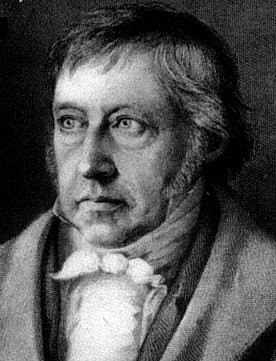
Georg Wilhelm Friedrich Hegel
(1770-1831)
Reason is the conscious certainty of being all reality.
Summary
- Like Kant's 'Antinomies', Hegel's dialectic instructed in three aspects. These were: the Thesis (Idea), Synthesis (matters of fact) and then the Antithesis (opposite). This is referred as the absolute. Say if the thesis was the weather is cold. There must have been a culmination of events to make the weather cold, and since only the absolute can exist, and cold does not just come from thin air, so only its opposite can take place.
- Hegel had a high nationalist regard for the state (German and Prussian especially). In his Philosophy of Law, Hegel addressed the matter of: "The state is the reality of the moral idea - the moral spirit, as the visible substantial will...which thins and knows itself." In other words, people exist for the benefit of the state and not the other way around.
- In his "Kingdom of Ends", Hegel tackles the subject of history. He claims that events themselves are cyclical and since Adam and Eve broke the peaceful existence of peace, time has since begun its curse. Take a river for example, as the constant flow won't cease for a moment even when you try to look at it. This "Positive Freedom" embodies the universal will of the state and determines a capacity for self-determination and what's right for a state. By following a fighting spirit, Hegel asserts time will stop and we will be reunited with God in the end. He was an ardent Protestant.
- Hegel can be compared to the philosophers Heraclitus and Spinoza. Like Spinoza, he saw the Whole concept being part of one embodiment (the 'super-person' as Russel refers) and Spionza with our souls all part of the Divine Being. Hegel's obsession with war can be compared to the renegade ancient philosopher, Heraclitus, who's obsession with war and passion can be compared to the idea of justifying war through strife in upholding 'life and property'.
- Hegel was a believer in the Geist (Ghost) spirit relates to the idea of self-determination once more and begins with the individual into coinciding to make a society which integrates love and reason altogether. His sense of freedom was that we have the right only to obey the law (a bit like Hobbes's Leviathan).
Hegel is an interesting case study. He's a bit of Kant, Hobbes and, at a push to the 'Will, his foe and rival, Schopenhauer. He saw 'Reason', as with the quotation mentioned above, as the "substance of the universe" and was perhaps the first individual after Locke to identify the idea of a stable government, with one nation presiding over its Social Contract. He comprehended to a great extent the needs for a constitutional monarch (executive), alongside which there will also exist a legislative body which would in turn advise the leader. However, much like Hobbes, he disagrees with forms of people power and saw that the sovereign had a God given right because he is the one who presides over the land. He is also much like Kant in respect we use our objective senses when seeing an object and this eventually falls into a triadic knowledge insofar as the fact the object is no longer distinct.It is important to bear in mind Hegel was a servant of the Prussian government, and much of his ideas do sound like a result of romanticised propaganda where the giest will be reunited with God.
Arthur Schopenhauer
(1788-1860)
No will: no idea, no world. Before us there is certainly only nothingness.
- Schopenhauer was a philosopher for the pessimist generation and became a figurehead against the German Idealist movement, which prevailed in figures such as Hegel at the time. He much preferred the subtler writing styles and even remarked in his writings: "Life is an unpleasant business… I have resolved to spend mine reflecting on it."
- Central to his idea was the 'Will'. He saw the human body as a perception to what really is the will and the 'Will' only causes pain and suffering, which to put in a metaphor, the soap-bubble which expands, to an end where we are all aware the bubble itself will burst.
- He was perhaps the first philosopher who found compassion and the nature of the soul with mammals outside the human race. The invisible, strength of the will is what drives them blindly to follow what is by instinct.
- The phenomena of the universe, the Maya (illusion), acts as a demon similar to that of Descartes. As an apparent atheist, Schopenhauer asserted that when removing the veil of the Maya, it is not God, but Satan, who reveals himself. Only by resignation from the will does the human race turn away from its insatiable desires.
- Our representation of the world is through the cognitive, spatio-temporal perspective of objects. A world constituted by the intellectual mind. Only when do we look at an object aesthetically and with regards to art does it become one of beauty and not plain cognition.
Schopenhauer is a widely undervalued and derided figure of philosophy. He solved Kant's solipsistic difficulty with the thing-in-tself, saying only that the Will within us and that perception in the body is caused by the will alone. Through this he made some intersting critiques upon Kant's innate nature of ethics. Like Hume, he regarded ethics as instrumental within our own Free Will and that actions themselves can be justified by the cause instead. He believed that compassion was inherent to the empathetic nature of what is felt to other human beings who suffer; this correlated perhaps with the Hindu and Buddhist faith ,hich Schopenhauer was a follower of. Although his bad tempurment and unpredictable nature seemed to work badly against his own preaching, failing to do so in practice. Russell observes that besides his fondness of animals "...he was completely selfish". It could be assumed therefore, against emperical and more optomistic philosophers such as Russell, Schopenhauer's pessemist ideas have only remained popular outside the most academic spheres of philosophy.
It must be said in his defence, however, when one regards the comparrison to his beliefs and that of the Utilitarian ideology, with whom Jeremy Bentham was a spearhead of, Schopenauer seems a much better alternative to the fanciful ideas of what is not heard can't be seen. Even Bentham's optimism was laughed at by Russell (see my latest seminar paper) and though the pessimistic outlook to rejct all forms of pleausre and aspiration, the 'ultimate form of happpiness' is a far more frightening prospect than one of complete misery. If, as Russell discusess, it is better to have two diffeent viewpoints, one may be that of Schopenhauer's, but maybe at the same time it is the suffering and the will which makes life worth living. If we were all to end associations of human strength and character, most of us do not have the residue strength to repress dark thoughts of suicide and putting that into action. After all, Schopenhauer didn't want any human to commit such an act, no matter the despair they live in. It's just best to be human and if that is somewhat lacking, look at Spinoza's theories again...

No comments:
Post a Comment