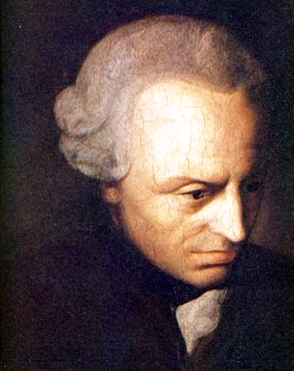
Immanuel Kant
(1724-1804)
Thoughts without content are empty; intuitions without concepts are blind.
Summary
- A rediscovery, particularly in The Critique of Pure Reason (1781/87), of the theories surrounding metaphysics and challenging empiricists such as Berkley, Hume and Locke.
- Concerned in the areas of aesthetics and ethics, Kant's founding of the "German Idealism", as it is referred to, changed dramatically the face of modern philosophy as it is known.
- Like Rousseau before him, Kant was religiously a very ambiguous character, calling the need for God "morally necessary". Although in this respect Kant, in his Ideals of Reason, called the need for religion a necessary capacity where we can posses knowledge.
- The 'Copernican' Revolution was essentially the founding of looking within whilst knowing that we still exist. It is impossible to determine our own existence without knowing there is something outside to distinguish. This known as the Phenomena (synthetic mental knowledge) and Noumenon (thing-in-itself, though this was later challenged by Schopenhauer).
- Claimed by synthetic apriori, we can sense our own judgement by what objects are in the world around us without having to use full intellectual capacity. This is very much like Aristotle's Logic of syllogism, by which statements such as "All men are mortal, Socrates is a man" etc. The analytic judgements, which may have been more empirical, are nonsensical and only lead into ridiculous logic.
What can one say in regards to Kant? To many he is the most difficult and inaccessible philosopher at present (though Russell disagrees and implies Hegel deserving of this title). For reasons beyond my difficulty in disecting a man with as significant as stature as Kant, I find much of his philosophy to be questionable - and that is never a good sign when holes appear so widely. His ethics, as any example, suggest that primarily through the Categorical Imperitive (or for a better word 'innateness) we are always aware when something is wrongfully committed. This "moral law within" is too subjective and circumstantial to be true. Take canniablism for an example, if a man were to his another man's flesh, would his conscience give him pangs in the first place to begin with? Kant says Reason itself acts with a "spontainaiety" that does not need to be precipiatated by another cause to follow an action. Why then does crime exist? Why, if God were to exist in a capacity of opposites of not actually being here, but at the same time there must be a being as a thing-in-itself, do people not obey the law for its own sake and morally gudied by their own wills which go into such an action. It may perhaps be compared to Locke's own views on the Laws of Nature and that by Nature, it guides humans to believe what was morally right, prior to the creation of government. He quotes: "The state of nature has a law of nature to govern it, which obliges every one; and reason, which is that law, teaches all mankind..." This seems a much fairer compromise than Kant's metaphysical implications.
I know come to the quotation that supports this account. In Kant's perception he is a philosopher he is what is known as an emeprical realist. Without content (a posterioir) we cannot gather knowledge, much to the credit of Hume's philosophy of causation, but without concept (thinking to Descartes "I think, therefore I am), we are without sense of the phsyical world as we would structure the world according to its representations. How would it be possible to know of our own existance by learning the functions of our own body, even if we don't know it? This can be deduced from the idea of Kant's "starry heavens" and the "moral law within", knowing that such causes exist by synthetically piecing the world in its current state. His greatest failure was perhaps 'the thing-in-tself' theory, which precepts are caused by the event in itself. It led to the only conclusion with which tim is subjective and precepts (principles) lose their case in being subjective. Schopenhauer later found that our inner Will is the underlying force which controls our inner bodily motions. This is best left to his own philosophy though, rather than Kant's. One final thing: Kant regarded the aftermath of the French Revolution i.e. the Reign of Terror to gain exective power and stability in government. This seed of nationalism was soon to evolve dramatically under Hegel's compulsive doctrine...
Coming Next..
Hegel: War, return to Eden and a very pecular sense of 'freedom'.
Schopenhauer: Pessimism, atheism and suppersing the desire of the Will...

No comments:
Post a Comment